

As Easter approaches, chocolate naturally takes center stage once again on store shelves, in marketing campaigns, and in consumers’ attention. But behind this seasonal highlight, another reality deserves a closer look: a cocoa supply chain facing growing demands for traceability, data structuring, and proof of compliance under the EUDR. Cocoa and several of its derived products are fully covered by the regulation, which notably requires that products be deforestation-free, legally produced, and covered by a due diligence statement.
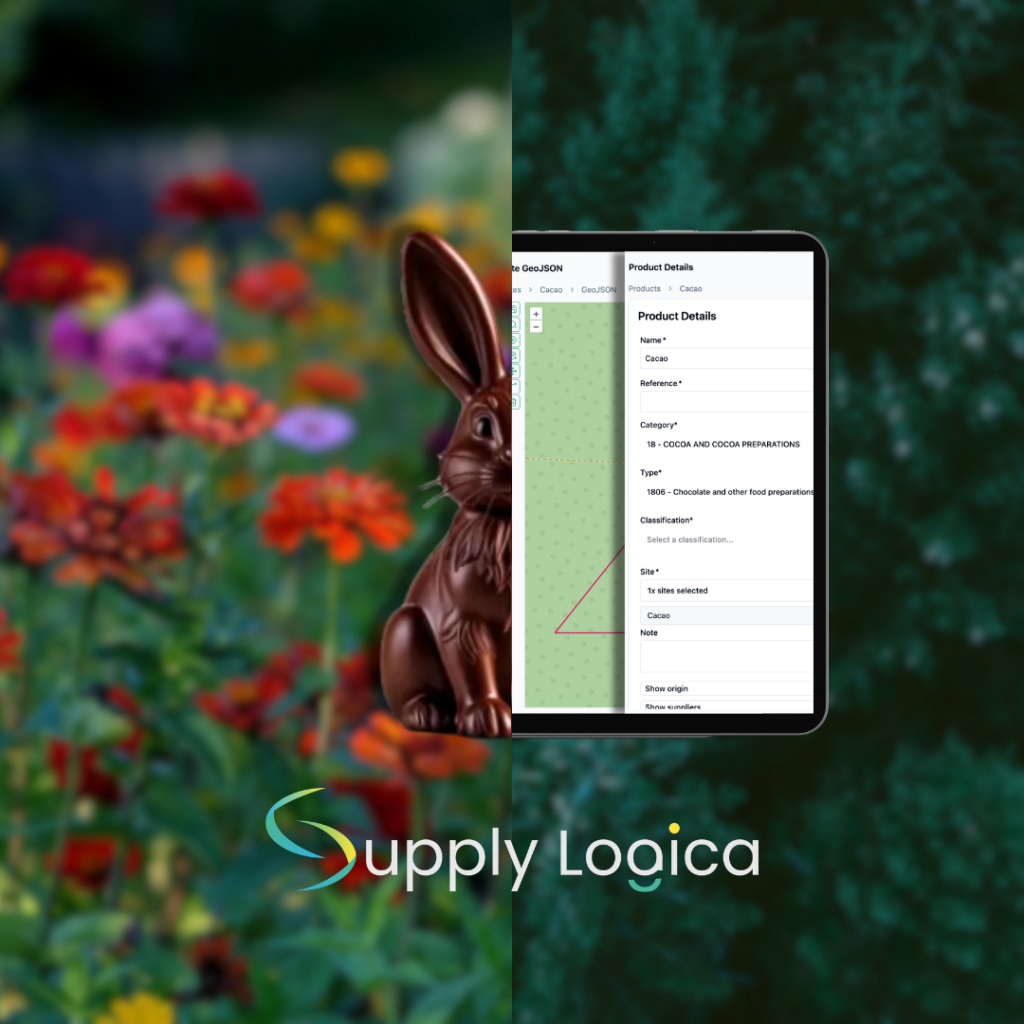
Chocolate draws attention. Data makes the difference.
In cocoa, compliance is not simply about gathering a few documents at the right moment. It requires linking plots, suppliers, physical flows, supporting evidence, and geolocation data into one coherent system. The European Commission also reminds us that the logic of the regulation is based on three clear steps: information collection, risk assessment, and, where necessary, risk mitigation. For cocoa, this logic also translates into a strong requirement to separate compliant flows from non-compliant or unknown-origin flows.
This is precisely what makes the cocoa sector so demanding. It often relies on long, fragmented, international supply chains, with very different levels of maturity depending on the actors involved. Between field data, documentation, intermediaries, logistics operations, and regulatory expectations, the challenge is not only to collect information. It is to collect the right information, structure it properly, and then make use of it quickly.
A sector that is moving forward, but still in fragments
That said, the cocoa sector is not standing still. It is trying to organize itself. And this is probably one of the most important signals right now.
At the sector level, the World Cocoa Foundation emphasizes the need to better qualify the data used for environmental monitoring and to move toward more comparable, transparent, and robust approaches across the industry. Its message is clear: without a shared framework, common criteria, and better-quality data, stakeholders expose themselves to misinterpretation, inconsistent reporting, and real difficulties in achieving compliance.
The same logic applies on the ground. In Ghana, the European Forest Institute highlights that supply chain readiness notably depends on the rise of national traceability tools, digitalized systems, and mechanisms able to better support operators’ due diligence efforts. This clearly shows the direction the sector is taking: more structuring, more clarity, more organization.
In other words, there is a broader trend at work. The cocoa sector is moving toward greater harmonization. It is not starting from scratch, but it is still working to strengthen its benchmarks, methods, and standards.
The real issue is not only collection. It is standardization.
This is where the topic becomes strategic for companies.
Because in a complex sector, the challenge is not only the volume of information to process. It is also the heterogeneity of practices. A document submitted in a different format, incomplete geographic data, a filing logic that changes from one supplier to another, a non-uniform verification method: these gaps, often more than the regulation itself, are what slow operations down.
Standardizing processes is precisely what helps reduce this friction. It means defining a common way to collect, verify, structure, and use information. It means creating a shared operational language across procurement, compliance, quality, supply chain teams, and external partners. And above all, it means turning a set of scattered tasks into a process that is clearer, more reliable, and easier to manage.
The World Cocoa Foundation’s recent work moves exactly in this direction: more standardized data enables more comparable assessments, better-informed decisions, and more credible compliance.
In cocoa, compliance is becoming a matter of operational architecture
This is probably the most important point.
The EUDR does not simply require companies to be compliant in theory. It pushes them to demonstrate that compliance in a structured way. In cocoa, that demonstration depends directly on the ability to circulate reliable information across several levels of the supply chain, without disruption, without loss of context, and without ambiguity regarding the origin or status of flows.
From this perspective, the challenge is not only regulatory. It is also organizational. The companies making the most progress are not necessarily those accumulating the largest number of documents. They are often the ones able to implement homogeneous, repeatable, and easily understandable processes across all teams.
Where Supply Logica provides a concrete answer
This is precisely where Supply Logica becomes fully relevant.
In a sector seeking to become more structured, the goal is not to add another layer of complexity. The goal is to provide a clear framework that makes compliance usable on a day-to-day basis. Centralizing relevant information, organizing documentation more effectively, securing traceability, reducing scattered processing, and making verifications more consistent: this is the logic that turns a regulatory obligation into an operational process.
For cocoa stakeholders, the benefit is direct. The more standardized the processes are, the more fluidly teams can work. The more structured the data is, the clearer controls become. The more consistent the files are, the easier it becomes to manage compliance over time rather than suffer through it in a state of urgency.
At Easter, cocoa reminds us of one simple fact: compliance must be prepared long before the finished product
Talking about cocoa at Easter is therefore far from anecdotal. On the contrary, it is a good moment to remember that behind a highly visible product lies a much less visible chain of information, one that has now become decisive.
The cocoa sector is complex. It is trying to organize itself. A clear trend is emerging toward more standardization, more traceability, and greater rigor in the use of data. In this context, process standardization is not a matter of comfort. It is a lever for robustness.
And this is precisely where Supply Logica has a role to play.