

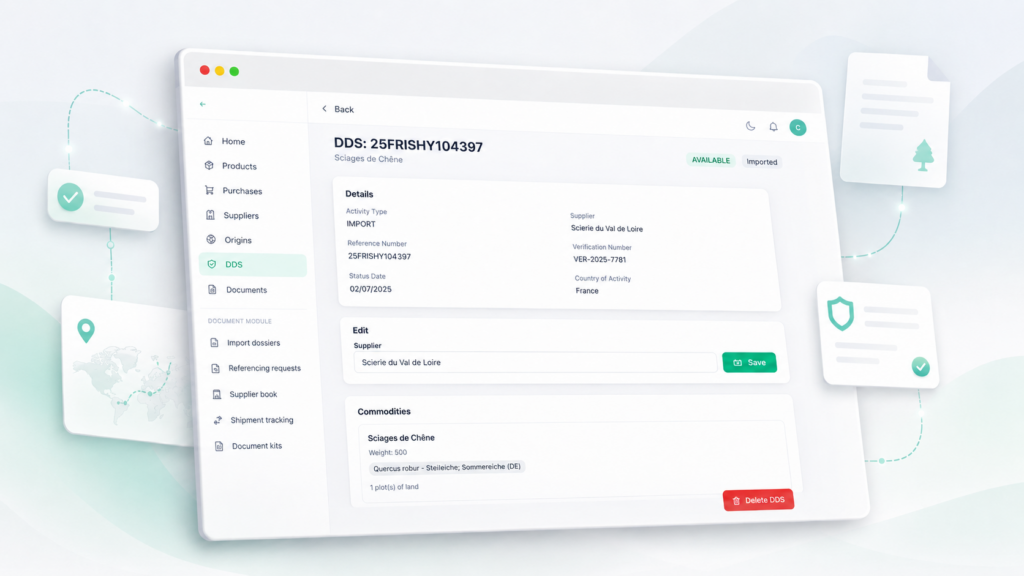
EUDR DDS submission is now possible again through TRACES, marking an important step for companies concerned by the EUDR. Due Diligence Statements, or DDS, can once again be submitted in the information system, allowing operators to continue their compliance-related procedures.
However, this reopening should not be seen as a simple technical resumption.
Under the EUDR, submitting a DDS is not just about filling in a form. It means declaring that the products concerned comply with the requirements of the regulation and that the company is able to demonstrate the robustness of its due diligence process.
In other words, the DDS is not the starting point of compliance. It is the outcome.
TRACES: A DDS registry, not a complete compliance solution
TRACES, or more precisely the EUDR Information System, allows companies to create, submit and monitor Due Diligence Statements. It therefore plays a central role in the regulatory framework.
However, it does not replace the compliance work that must be carried out beforehand.
Before submitting a DDS, the company must have collected, checked and structured the necessary information: supplier data, product origin, links to plots of land, geographic coordinates, supporting documents, risk analysis and any potential risk mitigation measures.
The real question is therefore not only: “Can I submit my DDS?”
The real question is: “Am I able to justify what I am declaring?”
Before submission: Essential due diligence work
To comply with the EUDR, companies must be able to demonstrate the traceability of the products concerned, from their origin to their placement on the market or export.
This notably involves checking the consistency of supplier information, linking products to the correct production plots, using geographic coordinates, analysing the documents provided and assessing the level of risk.
Every piece of data declared must be traceable, explainable and justifiable.
This is often where difficulties arise. Information is scattered across several departments, files, suppliers and formats. Documents may be incomplete, geographic data may be difficult to use, and evidence may not be structured enough to respond quickly to a control request.
How Supply Logica supports companies
Supply Logica helps companies move from scattered compliance to structured, traceable and manageable compliance.
The platform enables companies to centralize EUDR data, organize supplier information, link plots to products, monitor supporting documents, assess risks and prepare due diligence files before submitting DDS.
The objective is simple: to help teams avoid managing compliance in a rush, and instead manage it methodically, with the right data and the right tools.
With Supply Logica, DDS submission becomes part of a complete process: collection, verification, structuring, analysis, justification and submission.
Because under the EUDR, submitting a declaration is essential.
But being able to prove what you declare is just as essential.
Prepare your EUDR compliance before submitting your DDS
Before submitting a DDS, make sure your due diligence file is complete, structured and justifiable.
Supply Logica helps companies centralize supplier data, link products to plots, organize supporting documents, assess risks and prepare robust due diligence files before submission.
Contact our team to see how Supply Logica can support your EUDR compliance workflow.